Transistors are important electronic components used in circuits for signal amplification and switching control. Their basic working principle is to use a small signal to control a large signal, thereby amplifying the signal. This article will discuss in detail how transistors achieve signal amplification.
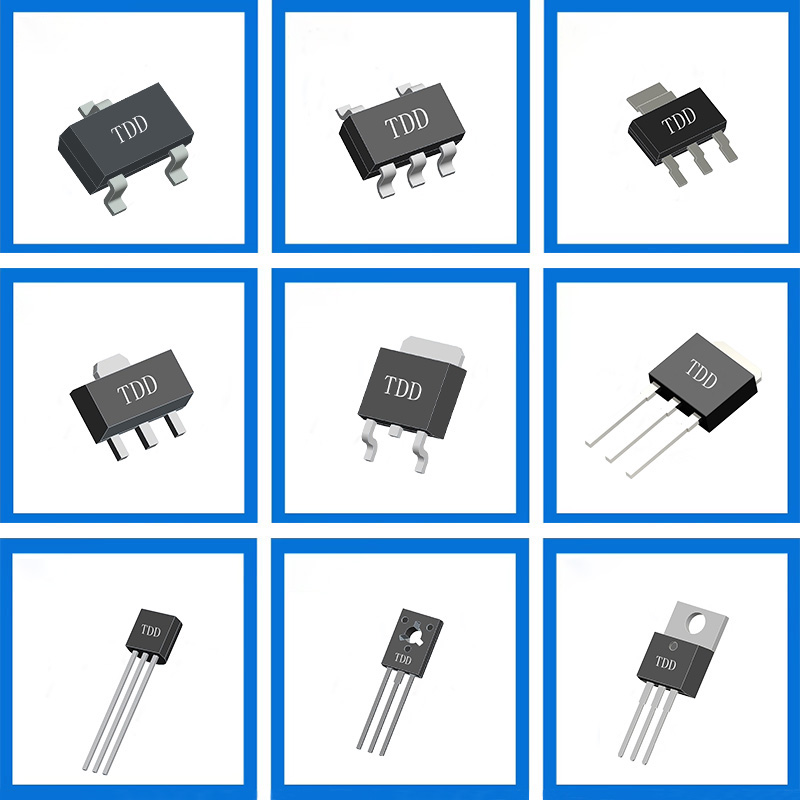
Transistors are mainly divided into two types: NPN and PNP. Regardless of the type, a transistor has three terminals: emitter (E), base (B), and collector (C). In an amplifier circuit, the base is the input terminal, the emitter is the output terminal, and the collector is used to provide the power supply voltage. Transistors mainly operate in three states: cutoff, amplification, and saturation. In amplification mode, the transistor effectively amplifies the input signal.
The amplification principle of a transistor can be understood through its current amplification characteristics. The operation of a transistor depends on the relationship between the base current (IB) and the collector current (IC). In amplification mode, the relationship between the collector current and the base current can be expressed by the formula: IC = β * IB, where β (beta) is the current amplification factor of the transistor. This formula shows that a small change in the base current can cause a large change in the collector current, thus amplifying the signal.
In practical applications, the amplification process of a transistor usually requires the assistance of external circuitry. First, the input signal enters the base through a coupling capacitor. The coupling capacitor isolates the DC component, allowing only AC signals to pass through. Changes in the input signal cause changes in the base current, which in turn causes changes in the collector current. Due to the amplification relationship between the collector and base currents, the amplitude of the output signal will be significantly higher than the input signal.
To ensure the transistor operates stably in amplification mode, a bias circuit must be considered in the circuit design. The bias circuit provides an appropriate operating point for the transistor, enabling it to operate in amplification mode. Common biasing methods include fixed bias, voltage divider bias, and emitter bias. By appropriately selecting the value of the bias resistor, the transistor can remain within the amplification range regardless of changes in the input signal, thus achieving stable signal amplification.
During amplification, the gain of the transistor is not only related to its materials and structure but also closely related to factors such as operating frequency and temperature. Therefore, when designing amplifier circuits, these factors need to be comprehensively considered to ensure appropriate amplification. Furthermore, the nonlinear characteristics of transistors also affect amplification, especially under large signal conditions, potentially leading to distortion. Therefore, in practical applications, designers need to select appropriate transistors based on specific requirements and make corresponding circuit adjustments.
Besides basic amplification, transistors can be combined with other components to form more complex amplifier circuits. For example, differential amplifiers and operational amplifiers are based on the amplification principle of transistors, achieving higher gain and better linearity. These circuits are widely used in audio amplification, signal processing, and other fields.
In short, transistors amplify the collector current by controlling the base current, thereby achieving signal amplification. In practical applications, proper circuit design and bias selection are crucial to ensuring stable transistor amplification. With technological advancements, the application areas of transistors are constantly expanding, becoming an indispensable and important component of modern electronics. By deeply understanding the working principles and characteristics of transistors, we can better utilize this component to design efficient and stable amplifier circuits.


